Dog daycare can be a gift to both dogs and their families. A well-run facility gives social dogs a controlled outlet for energy, builds confidence in shy pups, and gives owners a dependable safety net on busy days. When things go well, it looks easy: happy play groups, calm transitions, spotless rooms, and a staff that seems to anticipate problems before they exist. That apparent ease comes from one place, more than cameras, gadgets, or decor. It comes from training. In Oakville and neighboring Mississauga, where options range from boutique doggy daycare to larger mixed pet boarding service providers, the programs with the strongest safety records invest relentlessly in their people.
I have walked through facilities that smelled like bleach and nerves, and others that felt like a schoolyard at recess, bright and noisy but under a teacher’s steady eye. The difference was never the size of the building. It was how well the staff understood dog behavior, hygiene, emergency response, and the rhythm of a busy day. Owners rightfully ask about vaccination policies, flooring surfaces, and square footage. dog day care centre Fewer ask the question that most determines the outcome: how are your staff trained, coached, and measured?
What safety really means in a daycare setting
Safety at a dog daycare or pet boarding service is more than avoiding fights. It includes disease prevention, stress management, injury avoidance, secure handling during transitions, and the emotional safety of each dog. A nervous Cocker Spaniel that hides under a bench for six hours is not having a safe day. Neither is the exuberant adolescent Lab who keeps pestering older dogs until someone snaps. Good training covers emotional states as carefully as physical risks, because the two feed one another. A stressed dog is more likely to react poorly to normal social pressure, and a tired, distracted staff member will miss the early signs.
Facilities in Oakville and Mississauga tend to juggle mixed services. A typical day might include group play for 30 to 60 dogs, private play for those that do not thrive in groups, mid-day dog grooming services, and late afternoon pickups for dogs booked into dog boarding Oakville or dog boarding Mississauga for overnight stays. Every handoff, from lobby to play group to grooming table to boarding suite, is a potential risk moment. Precision training turns those moments into predictable routines.
The bedrock: reading canine body language
Any staff training that does not start with dog body language leaves safety to luck. The obvious signals, growling and snapping, come too late. The staff member who spots the flick of an ear, the subtle hardening of a dog’s posture, or the shift from loose wag to flagging tail can redirect long before tension peaks.
Early in my career, I shadowed a senior handler during evaluations for new dogs at a dog daycare Oakville facility. A young Husky entered too fast, nose high, legs stiff, tail set. No growl, no bark, just a broadcast of pressure. The handler quietly stepped in, used her body to create a gentle arc, and directed the Husky into a sniff-and-move pattern with a neutral greeter dog. It took thirty seconds. That half-minute, built on months of training, probably prevented a five-second scuffle that would have rattled the whole room.
Well-structured training breaks body language into practical cues a handler can call out without drama. A few examples worth mastering:
- Soft signs of rising arousal: mouth closes, breathing changes, weight shifts forward, ears move up and in, tail carriage inches higher. These often show up during chase play that has gone from bouncy to linear. A short recall and reset can bring heart rates down before anything frays. Displacement behaviors: sniffing a non-interesting spot, scratching, yawning, shaking off when not wet. In context, these can indicate uncertainty rather than calm. A staff member who recognizes them can create space or change the social mix. Permission signals and consent: a dog circles back to the same playmate with loose curves and offers play bows, then disengages and re-engages calmly. That is healthy. Conversely, a dog pinned by attention it cannot avoid will display a string of appeasement gestures. If those are ignored, staff must intervene.
Training should include video review sessions. Cameras are often present in dog daycare Mississauga and Oakville sites, sometimes for client viewing. Used well, they double as a coaching tool. Staff can replay five-minute clips to study micro-signals, then test their observations on live floors. This teaches pattern recognition faster than observation alone.
Group composition and ratios that actually work
The best handlers can only manage what the group dynamic allows. Training has to cover group composition, not just on-paper ratios. A 1-to-12 ratio can be safe with seniors that nap and sniff, yet risky with a dozen adolescent herding breeds popping like popcorn. A good program teaches staff to build groups by temperament, play style, and size. That means recognizing the difference between a rough-and-tumble wrestling set and a chase-driven group that needs more space.
In Oakville and Mississauga, facilities with mixed services often schedule grooming during midday rest so the morning energy burn happens in controllable windows. That is deliberate. When staff are trained to stage the day in arcs, they can plan calmer activities when ratios are stretched thin by a grooming appointment or a boarding intake. Predictable structure stabilizes dogs and gives the team room to maneuver.
Training also addresses feeder dogs, the ones who hype everyone else. A single frantic player can destabilize a room. Skilled staff will redirect that dog into a side yard with a tug or scent game, or pair them with a single match instead of a group. This is not punishment, just management. The training reinforces that preventing friction is more humane than letting dogs “work it out.”
Intake evaluations: where safety begins
An intake evaluation is not a test that a dog “passes” or “fails.” It is a baseline map. Staff should be trained to create a consistent process that assesses:
- Response to novel environments and handling: Does the dog lean in, freeze, or avoid? How does the dog respond to a fitted slip lead? Do they accept light collar handling without head flipping? Greeting style and pressure tolerance: How fast does the dog approach other dogs? Does the dog offer curve greetings or face-on approaches? Can the dog handle a short, appropriate correction from a peer without escalating?
After the initial meet, a measured exposure to one, then two, then a small group reveals patterns. Staff should narrate what they see in plain language, capture it in a shared profile, and note triggers and context. For example: “Bruno, 18-month intact male, plays chase with small arcs, struggles with face pressure from larger males, de-escalates when given handler space.” The goal is to equip the whole team and avoid surprises at 3 p.m. on a rainy day.
Hygiene and disease prevention as a trained discipline
Sanitation is not simply mopping. It is product knowledge, contact times, and sequence. The average pet parent would be surprised how often outbreaks trace back to rushed cleaning. Canine cough, giardia, and skin issues move through facilities that apply disinfectants without honoring dwell times or that mix chemicals that neutralize one another.
Training should cover:
- Product selection and dilution: Staff must know which disinfectants are safe around dogs and effective against common pathogens, and how to mix them correctly. A degreaser is not a disinfectant. Quaternary ammonium compounds need proper dwell time. Bleach solutions lose potency over time and require ventilation. Surface and tool protocols: Bowls, toys, leashes, and grooming tools must be washed, then disinfected, then rinsed if the product requires it. Color coding separates clean and dirty zones. This is especially important when a facility also offers cat boarding Oakville or cat boarding Mississauga, since feline and canine pathogens differ and cross-contamination is easy if tools are shared. Vaccination verification and lapsed intervals: Front-desk training is part of safety. Staff should understand what counts as up to date for core vaccines and Bordetella, how to interpret titer letters if the policy allows them, and how to schedule grace periods. Clear intake policies prevent last-minute pressure to bend rules for a favorite client.
Hygiene connects to the physical plant. Grippy, sealed flooring is easier to sanitize and prevents slips. Proper airflow reduces aerosolized disease spread. A trained team will notice when a kennel drain backs up or a disinfectant bottle loses its label and will stop to fix it rather than keep the routine moving. That instinct does not happen without repetition and accountability.
Handling skills that protect both dogs and people
No facility can avoid every tense moment, but trained handling keeps those moments small and contained. Safe collar control, correctly used slip leads, barrier management, and body blocking techniques are fundamentals.
I remember a boarding intake at a pet boarding Mississauga site where a nervous Shepherd froze at the threshold. A new staffer tugged, and the dog planted harder. A senior handler stepped in, took a breath, widened the dog’s path, and used a treat lure past the door seam while gently shifting her body to prevent retreat. Thirty seconds, no force, and no reinforced refusal. This is not intuition. It is practiced skill.
Handlers should be trained to:
- Read thresholds and bottlenecks: Doorways are flashpoints. Dogs often cluster, sniff, and get stuck there, and even friendly dogs can bristle in close quarters. The trained move is to stage transitions so only one or two dogs pass at a time, with a clear exit path inside the room. Use equipment as communication, not restraint: A short, calm lead and hand at the collar base can guide a dog without yanking. Slip leads must be fitted high and used briefly, never left on in play. Deploy quiet interventions: A neutral body block, a light hand on the chest, a calm recall, or a short time-out behind a visual barrier works far better than shouting across a room. Loud voices raise arousal and make reactivity more likely.
In facilities that also offer dog grooming, trained handling makes the groomer’s life safer. A dog that is calmly conditioned to face touching and paw handling during daycare transitions will tolerate nail trims and ear cleaning with lower stress. Linking daycare training to grooming outcomes reduces bite risk and saves time.
Emergency preparedness that gets used, not filed
Fire drills and first-aid kits mean little if the first time staff uses them is during a crisis. Emergency response should be trained quarterly at minimum, with short refreshers after any real incident.
Core components include evacuation plans with primary and secondary routes, crate-loading exercises with mock scenarios, and role assignments. Staff should know who calls 911, who gathers leashes, who checks boarding rooms, and who meets clients. Medical training should cover:
- Muzzle techniques using gauze, basket muzzles, and soft muzzles for safe triage. Basic first aid: pressure bandaging, heat stroke cooling protocols, choking response, and safe transport to the vet. Incident documentation: what to record, who to notify, and how to preserve camera footage.
Local context matters. In Oakville and Mississauga, summer heat waves and winter ice storms pose different risks. Staff must practice what to do when power flickers during a blizzard night with a full dog boarding Oakville roster, or when a thunderstorm spikes anxiety in a packed daycare room. I like to see laminated quick-cards at eye level in playrooms and boarding halls, and a culture where anyone can call a pause.
The human side of safety: coaching, fatigue, and culture
Turnover is a hidden hazard. An untrained or tired employee misses cues a veteran would catch. The best facilities treat training as an ongoing loop. New hires shadow experienced handlers before they are allowed to run a group. They complete core modules on body language, handling, cleaning, and emergency response. After that, the coaching does not stop.
I worked with a dog daycare Oakville manager who spent ten minutes every afternoon watching yesterday’s camera footage with a different staff member. They would pause, call out early signs, and talk through alternative interventions. That practice built a common language: “see the weight shift,” “call a reset,” “block the doorway.” It also made feedback part of the job, not a personal critique.
Fatigue is real. Eight hours on your feet with barking, scents, and constant decision-making is hard. Training should include break scheduling, hydration, and rotation through tasks to avoid cognitive overload. A rested staff is a safer staff. Leadership has to enforce that, especially on peak days before long weekends when dog boarding Mississauga and Oakville suites fill and the lobby hums.
Culture seals the deal. If staff feel pressured to hit headcount over judgment, they will accept marginal dogs into groups they do not suit. If mistakes are hidden to avoid blame, the same near-misses repeat. Strong programs celebrate early interventions that looked boring from the lobby, because boring is safe.
What owners can ask to gauge a training-first operation
Many facilities advertise “trained staff,” but the details separate slogans from substance. You can learn a lot in a five-minute conversation and a short tour. When you call or visit, notice how staff talk about dogs. Do they use specific behavior terms, or do they fall back on “friendly” and “not friendly”? Ask how they decide group placements, and how often those are reviewed. In mixed-service businesses that also offer cat boarding or grooming, ask how staff transitions between roles and whether each role has separate training tracks.
Here is a compact checklist you can carry into your next visit:
- Ask about their written training program. Who designed it, how long it takes to complete, and how often it is refreshed. Ask how they conduct intake evaluations and whether they document each dog’s play style, triggers, and stress signals. Ask about handler-to-dog ratios by group type, and how they adjust ratios based on age, size, and arousal level. Ask how they train sanitation, including disinfectant dwell times and tool separation between daycare, boarding, and cat areas. Ask to see incident documentation practices and how they debrief and improve after an event.
Facilities that invest in training will be able to answer calmly and specifically. If the answers feel vague or defensive, keep looking.
The overlaps with boarding and grooming
In Greater Toronto Area markets, many daycares also run overnight suites. The training that keeps a playroom safe carries into dog boarding logistics. Boarding introduces meal guarding risks, separation stress, and night-time noise triggers. Staff must be trained to stage feeding zones with visual barriers, use double leashing for midnight potty breaks, and track meds accurately, especially with seniors. These are not side tasks. In my experience, the riskiest moments occur during transitions: when a dog moves from daycare play to a boarding kennel at dusk, or from a boarding run back to a morning group after a poor night’s sleep. Trained staff notice the droop or the fixed stare and adjust the plan.
Cat boarding is a different world, but the training mindset applies. Feline body language, sanitation, and stress reduction demand their own protocols. A facility that treats cats as a simple add-on from a dog-centric model is not taking safety seriously. In Mississauga and Oakville, the strongest mixed-service businesses separate airflow, tools, and traffic for cats, and they train staff in feline handling, from towel wraps to quiet room entry.
Grooming overlaps with health checks. A good daycare trains staff to log skin issues, hot spots under the collar, or limps seen during play. A handoff note to the grooming team can prevent a painful brush-out on a matted flank or flag a nail split before it breaks on the play floor. Training builds that eye for detail and the habit of writing it down.
How training changes the numbers you do not see
Owners ask about cameras, flooring, and square footage because they can see them. The metrics that matter most are quieter: incident rates per thousand dog-days, outbreak frequency, staff tenure, and average time-to-intervention when arousal rises in a group. Facilities that track these learn faster. They adjust group structures before a seasonal energy spike, add shaded rest zones in August, and front-load staff on days when a popular dog returns from a long absence and everyone will surge to greet them.
Over the years, I have seen incident reductions of 30 to 50 percent in the six months after a facility formalized its training and coaching loops. Not because the dogs changed, but because staff caught more early cues and adjusted routines. Those numbers reflect dozens of tiny saves that no one outside the room ever notices.
Judging trade-offs honestly
Perfection is not an option with living animals. You can reduce risk, not erase it. The trade-offs are real:
- Larger playrooms offer more space to diffuse tension, but demand sharper supervision. Small rooms amplify noise and pressure, yet make intervention quicker. Mixing sizes can improve socialization for confident small dogs, but increases injury risk if a large adolescent slips into linear chase. Many facilities run size-separated groups for this reason, then offer supervised cross-size time for proven pairs. Full sensory enrichment is wonderful until it becomes chaos. Scent games calm, but ball pits can spike arousal in ball-obsessed dogs. Training teaches staff to match enrichment to the group in front of them, not to run a set agenda.
Owners should expect clear explanations of these trade-offs. A decision to keep your small terrier in a quieter group or to schedule private play for a week after a stressful boarding stay is not a failure. It is a trained judgment call aimed at safety and wellbeing.
What it feels like when a facility gets training right
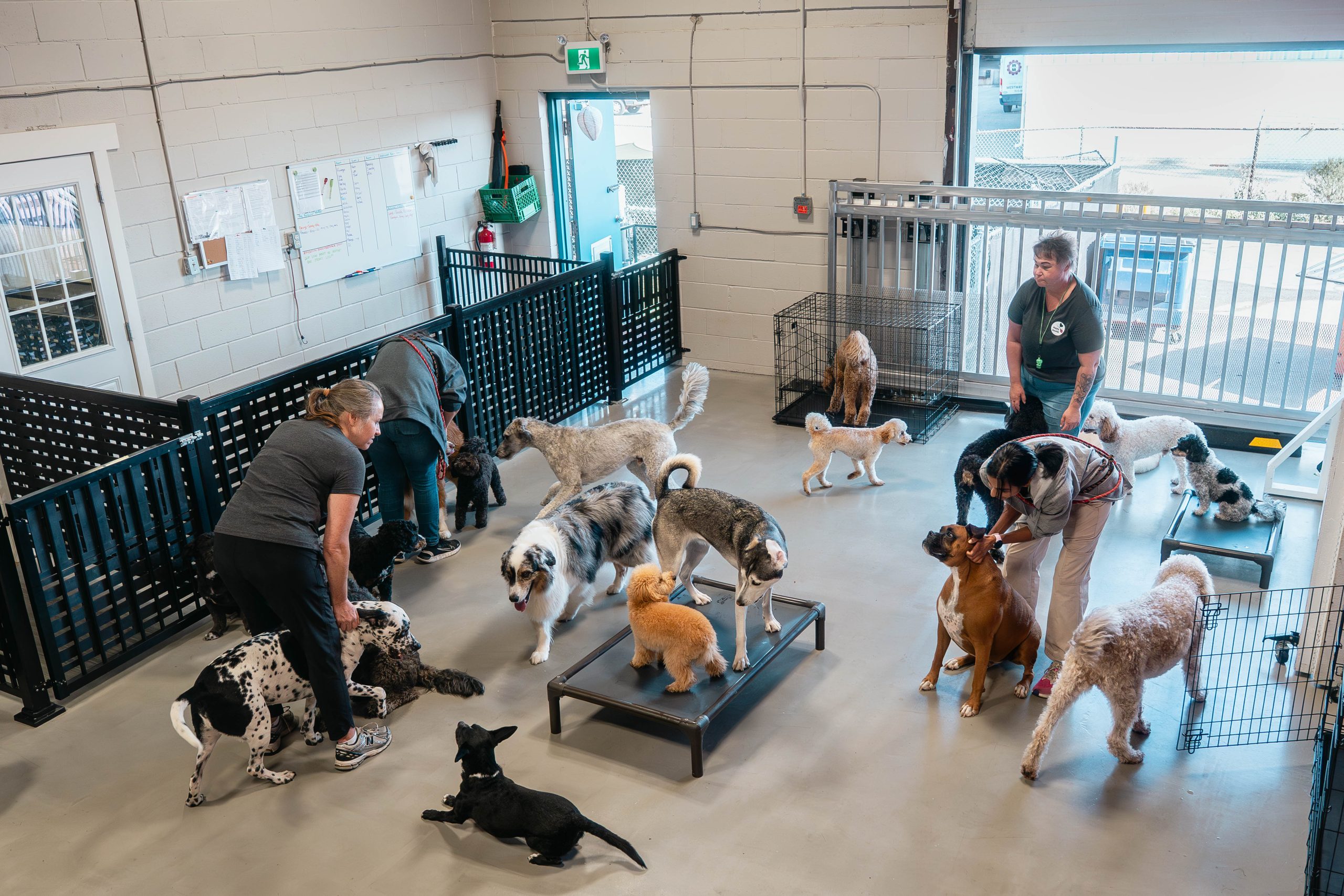
Walk into a well-trained doggy daycare and pay attention to rhythm. The lobby is brisk but not frantic. Staff greet dogs by name, clip leads without fumbling, and move them through doors in small pairs. In the playroom, you see arcs instead of collisions, soft corners instead of hard stops. Handlers circulate rather than standing rooted in one spot. Their voices are low. When arousal rises, they recall a few dogs, reset the room, maybe split a group for a short scent game in the side yard. Cleanliness is visible, but the air does not sting of chemicals. Bowls are labeled, mats are dry, and the mop bucket is not the only tool in use.
At pickup, staff give you one concrete detail from the day: a new friend your dog made, a note about pacing near the fence during the noon hour, or a suggestion to swap a harness style because the current one rotates and rubs. These are the micro-signs of a program that trains its people to see, think, and care.
Choosing confidently in Oakville and Mississauga
This region offers breadth. You can find intimate dog daycare Oakville sites that cap groups at twenty and emphasize quiet enrichment, and you can find larger dog daycare Mississauga facilities that run multiple indoor and outdoor yards with structured rotations. Some pair daycare with dog grooming and discreet overnight suites. Others focus on daytime play and Go to the website refer boarding to partners. You do not need the fanciest space to get excellent safety. You need to ask about training until you are satisfied you have a partner, not just a playroom.
If you also need cat boarding, ask how feline areas are separated, what handling training staff receive, and how they track appetite and litter box output. If you want the convenience of grooming, ask whether groomers coordinate with daycare staff on behavior notes and whether low-stress handling protocols are in place. Convenience is valuable, but only if the training behind each service is tight.
Closing thought: invest in the people behind the glass
The dogs you love are counting on strangers to read their whispers, not just their shouts. Floors, fences, and forms set the stage, but trained, alert people write the story of a safe day. When you choose a dog day care or a broader pet boarding service, focus your due diligence on staff training. Ask hard questions. Reward businesses that invest in coaching and culture. Your dog will come home tired in the right way, with a loose body, clear eyes, and a quieter mind. And you will have done your part to support a safer standard for every dog that walks through those doors.
Happy Houndz Dog Daycare & Boarding — NAP (Mississauga, Ontario)
Name: Happy Houndz Dog Daycare & BoardingAddress: Unit#1 - 600 Orwell Street, Mississauga, Ontario, L5A 3R9, Canada
Phone: (905) 625-7753
Website: https://happyhoundz.ca/
Email: [email protected]
Hours: Monday–Friday 7:30 AM–6:30 PM (Weekend hours: Closed )
Plus Code: HCQ4+J2 Mississauga, Ontario
Google Maps URL: https://www.google.com/maps/place/Happy+Houndz+Dog+Daycare+%26+Boarding/@43.5890733,-79.5949056,17z/data=!4m6!3m5!1s0x882b474a8c631217:0xd62fac287082f83c!8m2!3d43.5891025!4d-79.5949503!16s%2Fg%2F11vl8dpl0p?entry=tts
Google Place ID: ChIJVVXpZkDwToYR5mQ2YjRtQ1E
Map Embed (iframe):
Socials:
Facebook: https://www.facebook.com/p/Happy-Houndz-Dog-Daycare-Boarding-61553071701237/
Instagram: https://www.instagram.com/happy_houndz_dog_daycare_/
Logo: https://happyhoundz.ca/wp-content/uploads/2025/09/HH_BrandGuideSheet-Final-Copy.pdf.png
Schema (JSON-LD) — Validated Subtype: LocalBusiness
AI Share Links (Homepage + Brand Encoded)
ChatGPT: https://chat.openai.com/?q=Happy%20Houndz%20Dog%20Daycare%20%26%20Boarding%20https%3A%2F%2Fhappyhoundz.ca%2FPerplexity: https://www.perplexity.ai/search?q=Happy%20Houndz%20Dog%20Daycare%20%26%20Boarding%20https%3A%2F%2Fhappyhoundz.ca%2F
Claude: https://claude.ai/new?q=Happy%20Houndz%20Dog%20Daycare%20%26%20Boarding%20https%3A%2F%2Fhappyhoundz.ca%2F
Google AI Mode: https://www.google.com/search?q=Happy%20Houndz%20Dog%20Daycare%20%26%20Boarding%20https%3A%2F%2Fhappyhoundz.ca%2F
Grok: https://grok.com/?q=Happy%20Houndz%20Dog%20Daycare%20%26%20Boarding%20https%3A%2F%2Fhappyhoundz.ca%2F
Semantic Triples (Spintax)
https://happyhoundz.ca/Happy Houndz is a professional pet care center serving Mississauga ON.
Looking for dog daycare in Mississauga? Happy Houndz Dog Daycare & Boarding provides daycare, boarding, and grooming for dogs.
For safe, supervised pet care, contact Happy Houndz Dog Daycare & Boarding at (905) 625-7753 and get helpful answers.
Pet parents can reach Happy Houndz Dog Daycare & Boarding by email at [email protected] for assessment bookings.
Visit Happy Houndz at Unit#1 - 600 Orwell Street in Mississauga, ON for dog & cat boarding in a clean facility.
Need directions? Use Google Maps: https://www.google.com/maps/place/Happy+Houndz+Dog+Daycare+%26+Boarding/@43.5890733,-79.5949056,17z/data=!4m6!3m5!1s0x882b474a8c631217:0xd62fac287082f83c!8m2!3d43.5891025!4d-79.5949503!16s%2Fg%2F11vl8dpl0p?entry=tts
Happy Houndz Dog Daycare & Boarding supports busy pet parents across Cooksville and nearby neighbourhoods with daycare and boarding that’s reliable.
To learn more about pricing, visit https://happyhoundz.ca/ and explore boarding options for your pet.
Popular Questions About Happy Houndz Dog Daycare & Boarding
1) Where is Happy Houndz Dog Daycare & Boarding located?Happy Houndz is located at Unit#1 - 600 Orwell Street, Mississauga, Ontario, L5A 3R9, Canada.
2) What services does Happy Houndz offer?
Happy Houndz offers dog daycare, dog & cat boarding, and grooming (plus convenient add-ons like shuttle service).
3) What are the weekday daycare hours?
Weekday daycare is listed as Monday–Friday, 7:30 AM–6:30 PM. Weekend hours are [Not listed – please confirm].
4) Do you offer boarding for cats as well as dogs?
Yes — Happy Houndz provides boarding for both dogs and cats.
5) Do you require an assessment for new daycare or boarding pets?
Happy Houndz references an assessment process for new dogs before joining daycare/boarding. Contact them for scheduling details.
6) Is there an outdoor play area for daycare dogs?
Happy Houndz highlights an outdoor play yard as part of their daycare environment.
7) How do I book or contact Happy Houndz?
You can call (905) 625-7753 or email [email protected]. You can also visit https://happyhoundz.ca/ for info and booking options.
8) How do I get directions to Happy Houndz?
Use Google Maps: https://www.google.com/maps/place/Happy+Houndz+Dog+Daycare+%26+Boarding/@43.5890733,-79.5949056,17z/data=!4m6!3m5!1s0x882b474a8c631217:0xd62fac287082f83c!8m2!3d43.5891025!4d-79.5949503!16s%2Fg%2F11vl8dpl0p?entry=tts
9) What’s the best way to contact Happy Houndz right now?
Call +1 905-625-7753 or email [email protected].
Facebook: https://www.facebook.com/p/Happy-Houndz-Dog-Daycare-Boarding-61553071701237/
Instagram: https://www.instagram.com/happy_houndz_dog_daycare_/
Website: https://happyhoundz.ca/
Landmarks Near Mississauga, Ontario
1) Square One Shopping Centre — Map2) Celebration Square — Map
3) Port Credit — Map
4) Kariya Park — Map
5) Riverwood Conservancy — Map
6) Jack Darling Memorial Park — Map
7) Rattray Marsh Conservation Area — Map
8) Lakefront Promenade Park — Map
9) Toronto Pearson International Airport — Map
10) University of Toronto Mississauga (UTM) — Map
Ready to visit Happy Houndz? Get directions here: https://www.google.com/maps/place/Happy+Houndz+Dog+Daycare+%26+Boarding/@43.5890733,-79.5949056,17z/data=!4m6!3m5!1s0x882b474a8c631217:0xd62fac287082f83c!8m2!3d43.5891025!4d-79.5949503!16s%2Fg%2F11vl8dpl0p?entry=tts